Seeds and Food Sovereignty

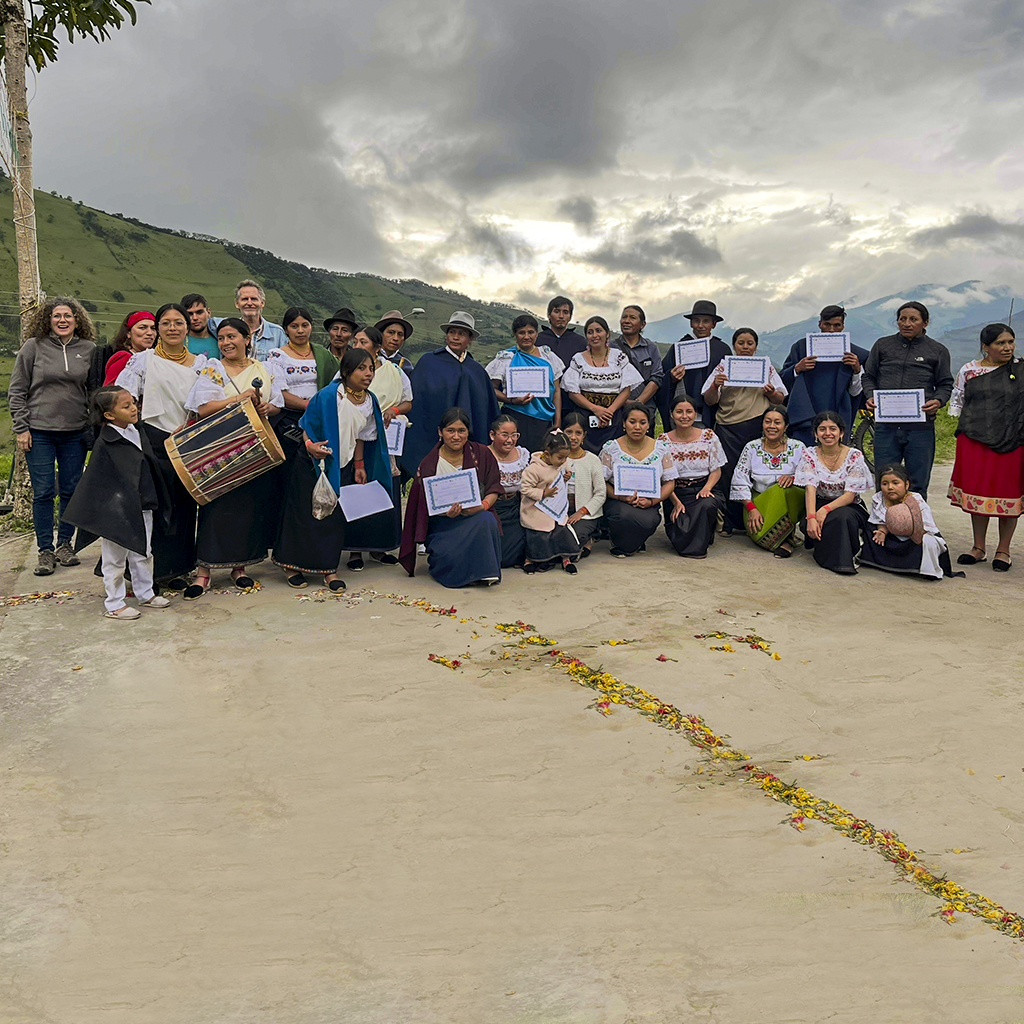
At Muyunsay, we understand that seeds are not simple grains: they are living chakras, beating hearts of Pacha Mama that hold within them the memory of our ancestors and the strength to regenerate life in each cycle.

Caring for, preserving, and sharing them is an act of spiritual, cultural, and ecological resistance, but above all, an act of profound resilience toward our Allpa Mama, “Mother Earth,” and future generations.

We work to strengthen food sovereignty from the ground up: recovering, conserving, and exchanging native seeds that sustain the diversity, identity, and health of those who grow and consume them.

🔸 What we propose:

  • Community seed guardians: men, women, youth, and scholars who safeguard genetic diversity as a collective legacy.
  • Tinkuy of seeds: exchange and barter gatherings, where not only seeds are shared, but also songs, stories, and living memories.
  • Training in agroecological conservation: selection, care, and multiplication of native seeds, always in harmony with the rhythms of the moon and the timing of the farm.
  • Defense of chemical-free and GMO-free crops, respecting the health of Pacha Mama and its inhabitants.
  • Community research and transmission of ancestral knowledge, where the words of the elders are combined with the practices of young people, ensuring continuity and resilience.
🔸 Our approach: In every seed we save and share, the hope of a free, diverse, and dignified future for our communities blossoms. Because without seeds there is no life, and without life there are no territories.

✨ With this proposal, seeds become a symbol of freedom, resistance and abundance, ensuring that future generations can continue sowing life.

Water Management and Ecosystem Restoration

The management of Yaku Mama (Mother Water) and the restoration of ecosystems in Muyunsay are fundamental processes for ensuring the life and balance of nature. Through ancestral practices and technological knowledge, we seek to restore the health of territories, protect water sources, and strengthen ecosystem resilience.

A respectful and harmonious relationship with water as a source of life is promoted, understanding its cycles and ensuring its availability for present and future generations.

🔸 What we propose:

  • Conservation and recovery of our Yaku Mama (mother water) springs, wetlands and watercourses.
  • Implementation of harvesting and planting knowledge of Yaku Mama (mother water) with tools such as: ky line, reservoirs, and infiltration ditches.
  • Integrated management of watersheds.
  • Edible forest practices with native species and soil restoration.
  • Community monitoring of the quality of Yaku Mama (mother water).
🔸 Our approach: Strengthening is based on theoretical, practical, and experiential approaches, integrating ritual, science, and community action. Active participation in ecological restoration processes, the care of forests, moorlands, rivers, and streams, and the connection with awareness of the interdependence between Yaku Mama (water), land, and life are encouraged.

✨ Through this process, participants become guardians of water and nature, capable of regenerating ecosystems and ensuring water sovereignty for their communities.

Bioarchitecture and Renewable Energies

Bioarchitecture and renewable energy are a path toward harmony between humans, their homes, and Pacha Mama (Mother Earth).

We design and build spaces that respect the environment, inspired by the use of local materials, ancestral techniques, and contemporary technologies that reduce environmental impact.

The goal is for people and communities to develop healthy, efficient, and resilient housing and collective spaces, fostering a life in balance with the cycles of Allpa Mama (Mother Earth) and the Samaykuna (energies).

🔸 What we propose:

  • Construction with local materials, from Allpa Mama (Mother Earth) and recycled materials.
  • Bioclimatic design that efficiently uses light, air and heat.
  • Implementation of solar, wind and hydraulic energy systems.
  • Appropriate technologies for waste management and ecological sanitation.
  • Creating spaces that strengthen coexistence, health, and well-being.

🔸 🔸 Our approach: The training is practical, creative, and community-based, integrating ancestral construction knowledge with current technological innovation. The goal is for people to not only learn techniques but also develop a new relationship with Allpa Mama (Mother Earth) and the Samaykuna (energies).

✨ With this experience, participants become conscious builders, capable of building homes and communities that breathe with Pachamama (nature), generating clean energy and caring for our common home: Allpa Mama (Mother Earth).

Training in Sustainability and Permaculture.

We weave the future in reciprocity, learning to live in harmony with Pachamama.

Training in Sustainability and Permaculture. Muyunsay It is an educational process that integrates ancestral knowledge and contemporary knowledge to design lifestyles in balance with nature.

It is intended that people and communities learn to observe, understand and work with natural cycles, generating productive, energy and social systems that are self-sufficient, resilient and regenerative.

🔸 What we propose:

  • Design of productive spaces that imitate natural ecosystems.

  • Water, soil and biodiversity conservation practices.

  • Production of healthy food using agroecological and biocultural techniques.

  • Use of renewable energy and appropriate technologies.

  • Natural construction and eco-housing solutions.


✨ With this training, participants become guardians of the territory, capable of applying the principles of permaculture to regenerate the land and build sustainable communities.

🔸 🔸 Our approach:  The training is theoretical-practical and experiential, promoting the exchange of knowledge, the creation of community projects and the implementation of sustainable models that strengthen the food sovereignty, care for the land and good living (sumak kawsay).

✨ ✨ With this training, participants become guardians of the territory, capable of applying the principles of permaculture to regenerate the land and build sustainable communities.